Many of you reading this have cholesterol plaque in your arteries and do not know it. A new study imaged the arteries of nearly seventeen thousand people with no known heart disease and found plaque in more than half of those with complete scans.
I am a neurosurgeon. I operate on plaque in the carotid artery and in the brain. So I read this paper carefully, and I want to tell you what it shows, what it does not, and where I worry it will get spun.
What the Study Did
The REACT study came out of Copenhagen and Madrid. It was presented at the European Society of Cardiology Congress and published the same day in the New England Journal of Medicine. The investigators enrolled 16,808 adults between 18 and 70 with no prior heart attack, stroke, bypass, or stent, and imaged their arteries with three-dimensional ultrasound of the carotid and femoral arteries plus a CT angiogram of the heart. The main analysis covered the 13,186 people who completed all three scans.
What It Found
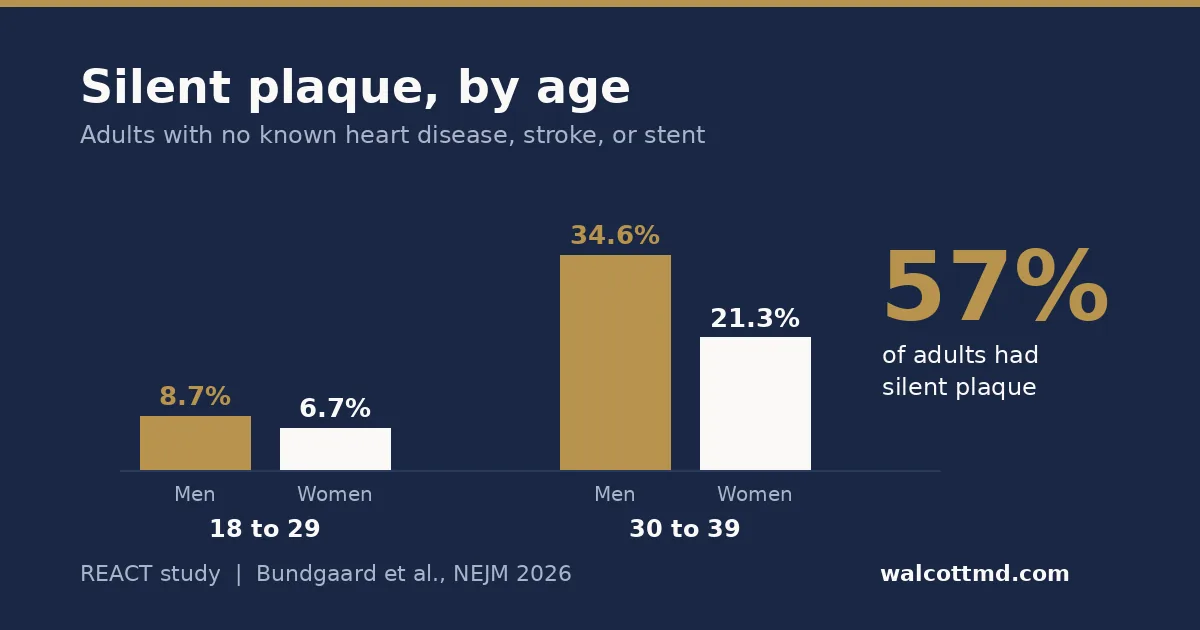
Fifty-seven percent had plaque. Silent plaque, in people who felt fine.
It was already there in the twenties: 8.7% of men and 6.7% of women aged 18 to 29. In the thirties it jumped to 34.6% of men and 21.3% of women. Men start earlier, by five to ten years. Women catch up hard in midlife, right around menopause. In young people the disease usually sat in a single artery, most often the carotid. With age it spread across territories and the total burden grew exponentially.
Why This Is a Great Study
This is a huge undertaking, and it answers a question we have never had a clean answer to: what does the natural history of atherosclerosis look like across an entire adult lifespan? Now we know. You can see it in your twenties. It takes decades to hurt you. Starting a statin at seventy does not undo fifty years of exposure, and the trials that lower risk the most are the ones that lower it early and keep it low.
What It Does Not Show
Here is where I get careful, because this is where the findings will be spun.
- It is a snapshot. Nobody in this paper was followed forward. It cannot tell you whether the 28-year-old with a speck of carotid plaque is going to have a stroke.
- It tested no treatment. Nobody was randomized to scan versus no scan. Finding plaque in half the population is not the same as knowing what to do about it.
- It did not show that identifying plaque changes outcomes. The investigators have announced a randomized trial to test whether treating what you find prevents heart attacks and strokes. That trial has not been done. Until it is, screening the general population on the strength of this study is not evidence-based medicine.
More testing is not automatically better testing. Every scan generates findings, every finding generates anxiety and follow-up, and none of that has yet been shown to prevent a single stroke.
Risk Scores and Calcium Scores
Our standard risk calculators are built to predict events over the next ten years. A 35-year-old with plaque has almost zero ten-year risk, so the score says you are fine. In this study, a high risk score identified less than two percent of people with disease. That is not a failure of the score. It is answering a different question. Risk scores estimate events. Imaging finds disease.
The same caution applies to coronary calcium scores, which I see people getting left and right in their thirties. In this study, among people aged 30 to 39 who had coronary plaque, 41.8% of men and 48.4% of women had a calcium score of zero. A zero at 35 is not a clean bill of health. It is a test that was never designed for you.
Where I land
I would not run out and get a scan. I would get my cholesterol and blood pressure checked in my twenties and act on the numbers, because the disease is already there whether you look or not. The intervention that matters is not the imaging. It is the decades of low cholesterol and normal blood pressure that follow.
This is one of the best natural history studies of atherosclerosis ever done. Respect it for what it is, and do not let anyone sell you a scan on the strength of it.
Source: Bundgaard H, et al. "Prevalence of Silent Atherosclerosis across Adult Life." N Engl J Med (2026). DOI: 10.1056/NEJMoa2609059