We just got a huge win for longevity medicine. And no, I do not mean the supplement stacks and the biological age tests. I mean the kind of longevity medicine where people with cancer actually live longer.
I am a neurosurgeon. I run clinical trials, I treat cancer patients, and I have watched this technology develop for a decade. Here is what happened, how it works, where it is headed, and where it has already stumbled.
The News
On August 19, Moderna and Merck announced that their personalized mRNA cancer vaccine, intismeran autogene, passed its first phase 3 trial. INTerpath-001 enrolled 1,137 patients with high-risk melanoma whose tumors had been surgically removed. The vaccine plus pembrolizumab immunotherapy beat immunotherapy alone at keeping cancer from coming back and keeping it from spreading. It is the first positive phase 3 result ever for an mRNA cancer therapy.
One caveat that matters: this is a press release, not published data. We do not have the phase 3 hazard ratios yet, and Merck typically holds the numbers for a medical meeting. The reason I believe the headline is the phase 2 trial that came before it. At five years of follow-up, adding the vaccine cut the risk of recurrence or death by 49% and the risk of distant metastasis or death by 59%. The phase 3 appears to be tracking along with that, but "appears" is doing real work in that sentence until the full data drop.
How It Works
They sequence your tumor. Your specific tumor, with its specific mutations. Then they write a custom strand of mRNA encoding up to 34 of those mutant proteins, inject it, and your immune system learns to recognize your cancer and hunt it down. It is a wanted poster for your T cells.
Elon Musk, not exactly an mRNA cheerleader lately, reacted to this news by saying artificial RNA essentially makes curing disease a software problem. For cancer, that is the right frame. The hardware is your immune system. The vaccine is just new code.
Where the Trials Stand
Melanoma is the opening act, not the whole show. Here is the current landscape of personalized mRNA cancer vaccine trials across companies and cancer types.
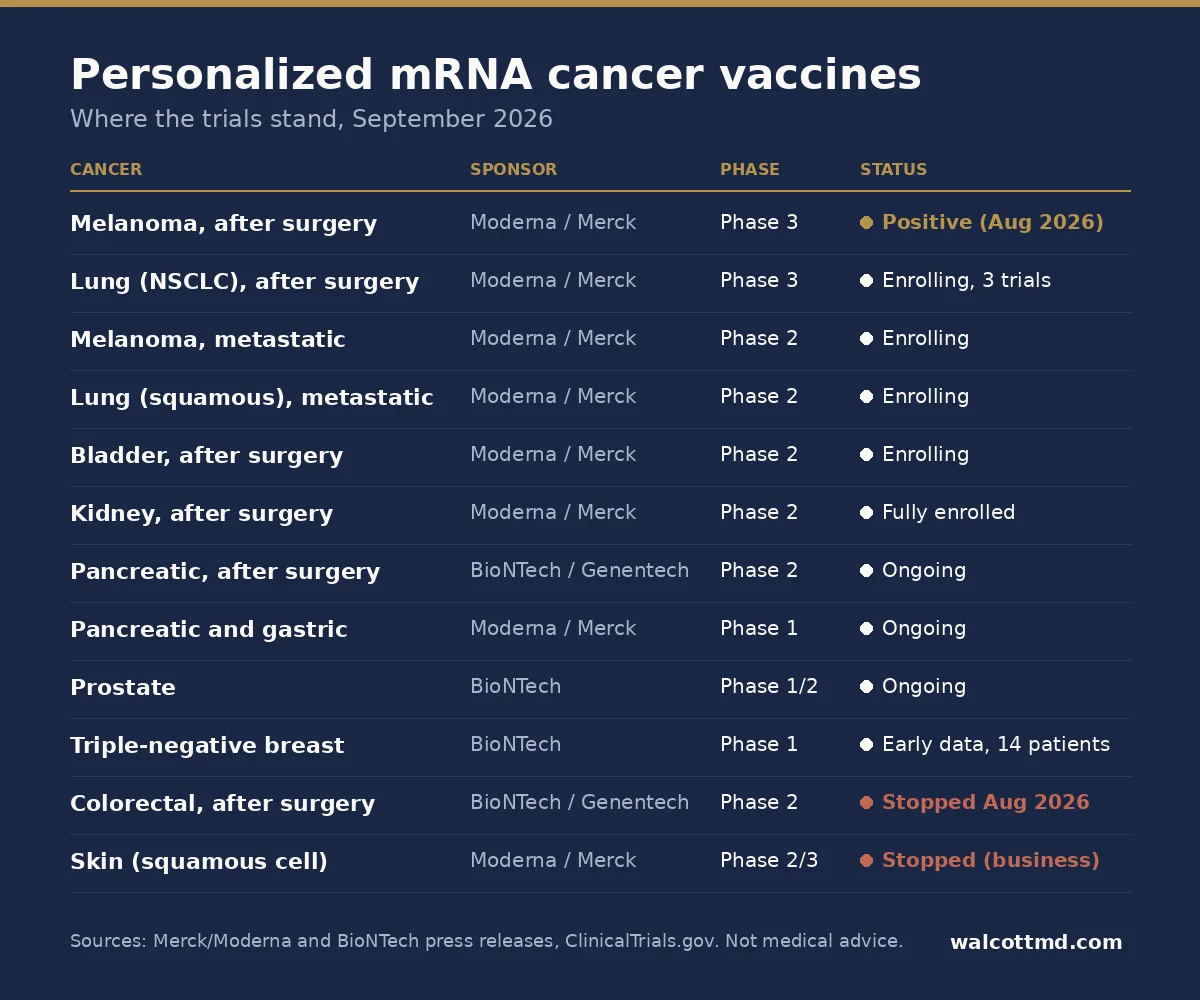
The Moderna and Merck program alone runs nine phase 2 and 3 trials across melanoma, lung, bladder, and kidney cancer, including three phase 3 trials in lung cancer. BioNTech, the company behind the Pfizer Covid vaccine, is running its own personalized vaccine in pancreatic cancer and has reported early data in triple-negative breast and prostate cancer.
The Setbacks
I share the wins, so I owe you the losses. The program is not undefeated.
On August 28, BioNTech and Genentech terminated their phase 2 colorectal cancer trial. The design was clever: after surgery, they used a blood test for circulating tumor DNA to find the patients most likely to relapse, then gave them the vaccine alone versus watchful waiting. The independent safety board found a numerical imbalance in overall survival between the arms and concluded that continuing would not change the outcome. No new safety signal was identified. The trial simply did not work.
Why melanoma and not colorectal? Melanoma carries one of the highest mutation burdens of any cancer, which means many targets for the immune system to learn. Most colorectal cancers carry far fewer mutations and sit in an immune-suppressive environment that has resisted immunotherapy for years. And this trial tested the vaccine by itself, without a checkpoint inhibitor. The melanoma win came with pembrolizumab on board. The lesson may be less "mRNA fails in colorectal" and more "a wanted poster does not help if the police have been told to stand down."
Moderna and Merck also ended a phase 2/3 trial in cutaneous squamous cell skin cancer, though that was described as a business decision rather than a failure of the science.
What to watch
The full phase 3 melanoma data at an upcoming medical meeting, including the actual hazard ratios and absolute benefit. Then the lung cancer phase 3 trials, which are the real test of whether this becomes a platform or stays a melanoma story. And the practical questions nobody has answered yet: what individualized manufacturing costs, how long it takes, and who pays.
Real Longevity Medicine
So the next time an infomercial tries to sell you a spike protein detox, remember what mRNA is actually doing right now. It is not poisoning anybody. It is teaching immune systems to kill cancer, in randomized trials, with survival curves. Some of those trials fail, and the companies say so publicly. That is what real science looks like.
That is real longevity medicine.
Sources: Merck and Moderna press release, August 19, 2026 (INTerpath-001, NCT05933577). KEYNOTE-942 five-year follow-up, ASCO 2026 (HR 0.51 for recurrence-free survival, HR 0.41 for distant metastasis-free survival). BioNTech press release, August 28, 2026 (BNT122-01, NCT04486378). Not medical advice. Talk to your oncologist.