I am a brain surgeon. Some of the deadliest tumors I remove from people's heads did not start in the brain. They started in the lung.
Lung cancer is one of the most common sources of the brain metastases I treat. So when a study suggests we might be able to see lung cancer coming more than five years before it shows up, I pay attention.
What the Study Found
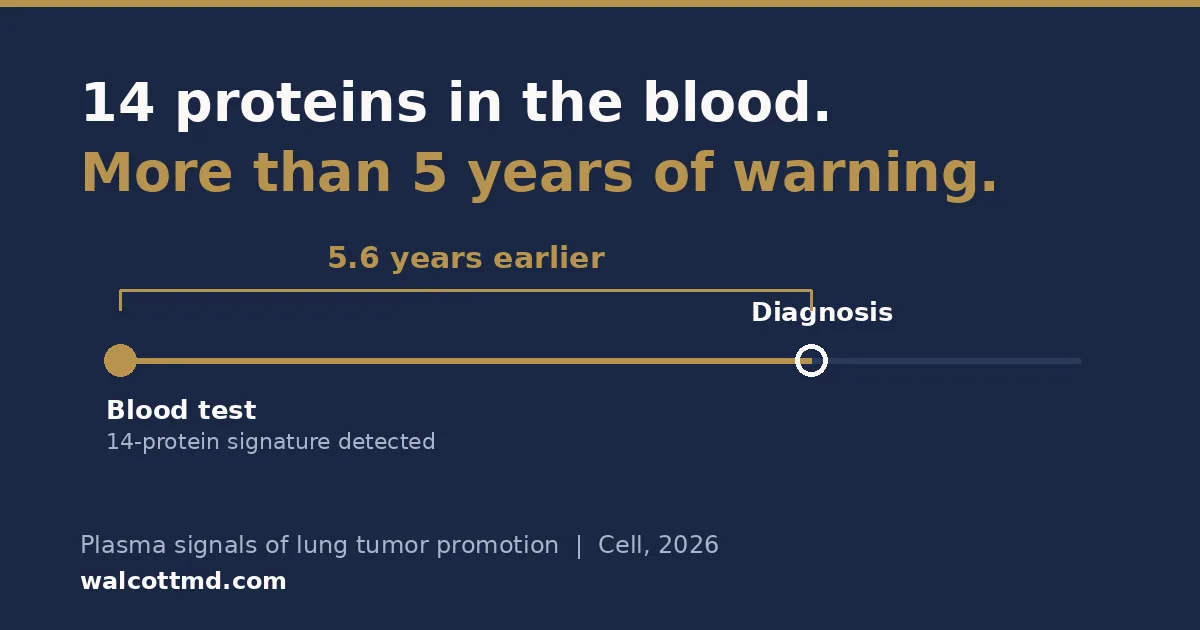
A new study in Cell did something researchers have been chasing for decades. The team ran machine learning on blood samples from over 48,000 people and found a signature of just 14 plasma proteins that predicts lung cancer risk more than five years before diagnosis. They then validated it across eight separate cohorts on four continents, including people who never smoked.
Here is the part that changes how you should think about it. This is not detecting a tumor. There is no tumor yet. The signature detects the inflamed state of the lung that allows a tumor to take hold. It is measuring the soil, not the seed.
The Biology: Tumor Promotion
Most of us carry cells with cancer-associated mutations. The vast majority never become cancer. What tips the balance is a process called tumor promotion, where inflammation wakes up these dormant mutant cells and pushes them toward malignancy.
One of the key signals in that process is a molecule called IL-1 beta. Air pollution and certain mutations trigger it. The 14 proteins in this signature are essentially the fingerprint of that inflammatory process at work.
And here is what makes this more than an academic finding. We already have a drug that blocks IL-1 beta. In a retrospective look back at a large cardiovascular trial called CANTOS, people with a high-risk signature who received the IL-1 beta blocking antibody canakinumab had nearly half the lung cancer risk of those who did not.
Why "Promolytics" Matters
Cancer researchers have started using a new word for this class of therapy: promolytics. These are agents designed to interrupt tumor promotion itself, stopping dangerous cell populations before they ever become cancer. An international Cancer Grand Challenges team called PROMINENT is actively pursuing this strategy.
The statin analogy
Think about how we prevent heart attacks today. We measure a marker of risk, LDL cholesterol, and treat people with statins long before any symptoms appear. This blood signature could become something like an LDL for lung cancer: a measurable risk marker paired with a preventive therapy. That is the vision, and this study is the first credible sketch of it.
The Honest Caveats
I share hopeful science, but I share it honestly. Several things need to be true before this changes clinical care:
- This was a retrospective study. Researchers went back through old blood samples and cancer registries. No prospective trial of the signature has launched yet.
- The canakinumab finding comes from a post-hoc analysis of a trial designed to study heart disease, not cancer prevention. It generates a hypothesis. It does not prove one.
- There is no clinical test available today. The signature still needs standardized thresholds before it can be used in practice.
- Randomized controlled trials must show that treating people flagged by this signature actually prevents cancer. The study authors themselves say this is the necessary next step.
Prevention Over Treatment
By the time a lung cancer has spread to the brain, we are fighting from behind. I can remove a metastasis. I can treat it with focused radiation. What I cannot do is undo the years in which that cancer grew undetected.
That is why this study matters to me as a neurosurgeon. Every lung cancer prevented is a brain metastasis that never happens. It is always better to prevent than to treat.
The data looks strong, the drug already exists, and the field is moving. Cancer can be a dark place, so I think it is important to shine a light when there is real hope.
Source: Pandya T, et al. "Plasma signals of lung tumor promotion for molecular cancer prevention." Cell (2026). DOI: 10.1016/j.cell.2026.05.005